Stabledash

Stabledash

Click to play
Click to play

Click to play

Click to play

Click to play

Click to play

Click to play

Click to play

Click to play

Click to play

Click to play
Click to play

Click to play

Click to play

Click to play

Click to play

Click to play

Click to play

Click to play

Click to play

Click to play

Click to play

Click to play

Click to play

Click to play

Click to play

Click to play

Click to play

Click to play

Click to play

Click to play

Click to play
Click to play
Season 7, Episode 4
Guest:
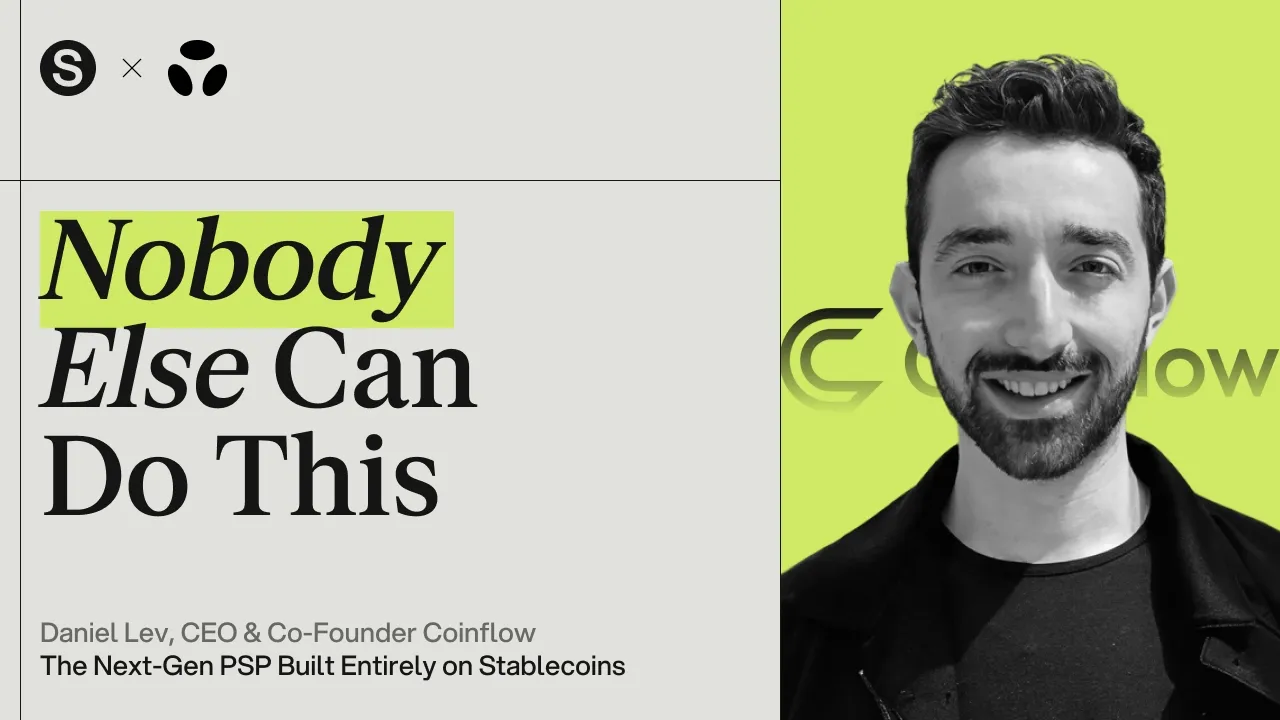
Daniel Lev, CEO & Co-Founder of Coinflow
In this episode, Daniel Lev, CEO and co-founder of Coinflow, breaks down how his team built the only payments platform that settles merchants instantly via stablecoins while indemnifying them from all fraud liability. After selling a gaming company right after the FTX collapse, Daniel saw the value of instant payouts firsthand and turned that internal fintech into Coinflow. Three years later, they closed a $25M Series A led by Pantera Capital.
The conversation covers why stablecoins are the only infrastructure that can enable true instant settlement, how Coinflow combines payments processing, fraud indemnification, and stablecoin settlement into one vertical stack, and why that combination is what makes it so difficult for anyone else to replicate. Drew and Daniel also get into how Coinflow's fraud detection model works in real time, using thousands of data points and behavioral analysis rather than hard-coded rules.
Daniel explains how Coinflow serves marketplaces, remittance companies, and prediction markets, why Venmo and PayPal payouts are their fastest growing method, how legacy PSPs like Shift4 are partnering with Coinflow because they can accept stablecoins but can't settle on them, and what the card present opportunity looks like heading into 2026. He also breaks down the Brale partnership on Instant Treasury and why the snowball effect of upstarts using stablecoin settlement to beat incumbents is now replicating across every vertical.
Key Timestamps:
00:00 - "Why aren't other people doing this? Combining all these together is incredibly difficult."
02:35 - What Coinflow is: a next-gen PSP that settles in five seconds via stablecoins
03:53 - From a gaming company to payments: the Coinflow origin story
05:53 - Core verticals: marketplaces, remittances, and prediction markets
08:15 - "You're opening Pandora's box": instant money as a honeypot for fraudsters
12:36 - How Coinflow's fraud model learns from user behavior in real time
16:05 - "Design me a Coinflow that settles instantly. You can't do that without stablecoins."
20:16 - Why Coinflow is different from Bridge, BVNK, and orchestration layers
24:37 - Working with Shift4 and legacy PSPs who can't settle on stablecoins
27:43 - Card present vision: the New Year's Eve server tip example
31:33 - Venmo and PayPal payouts: the fastest growing payout method
37:58 - "None of these are trivial, but they're not that hard. Combining them is incredibly difficult."
41:24 - The snowball effect: why stablecoin payments grow no matter what happens to crypto
Whether you're building payments infrastructure, exploring how stablecoins change the settlement layer, or trying to understand what it actually takes to verticalize payments, fraud, and instant settlement into one platform, this episode delivers the operational clarity that most stablecoin conversations skip.
Learn more about Coinflow at coinflow.cash
This season is powered by Brale
With Brale, you can launch stablecoins in minutes and actually make them usable. Their single API unifies licensing, custody, on-ramps and off-ramps. They're the stablecoin issuer for emerging ecosystems like Canton and Radius, and core infra for payments teams like Coinflow, Rain, and hundreds of others.
Learn more at brale.xyz
Guest: Daniel Lev, CEO & Co-Founder at Coinflow
Host: Drew Rogers
Follow Stabledash on X: @stabledash
Follow Coinflow on X: @CoinflowLabs
Follow Daniel on X: @SirDigitalDan
#Stablecoins #Coinflow #Payments #PSP #FraudPrevention #InstantSettlement #Fintech
The content of this podcast is for informational purposes only and does not constitute financial, investment, or legal advice.