Stabledash

Stabledash

Click to play

Click to play

Click to play

Click to play

Click to play

Click to play

Click to play

Click to play

Click to play

Click to play

Click to play

Click to play

Click to play

Click to play

Click to play

Click to play

Click to play

Click to play

Click to play

Click to play

Click to play

Click to play

Click to play

Click to play

Click to play

Click to play

Click to play

Click to play

Click to play

Click to play

Click to play

Click to play

Click to play
Season 7, Episode 6
Host:
Drew Rogers
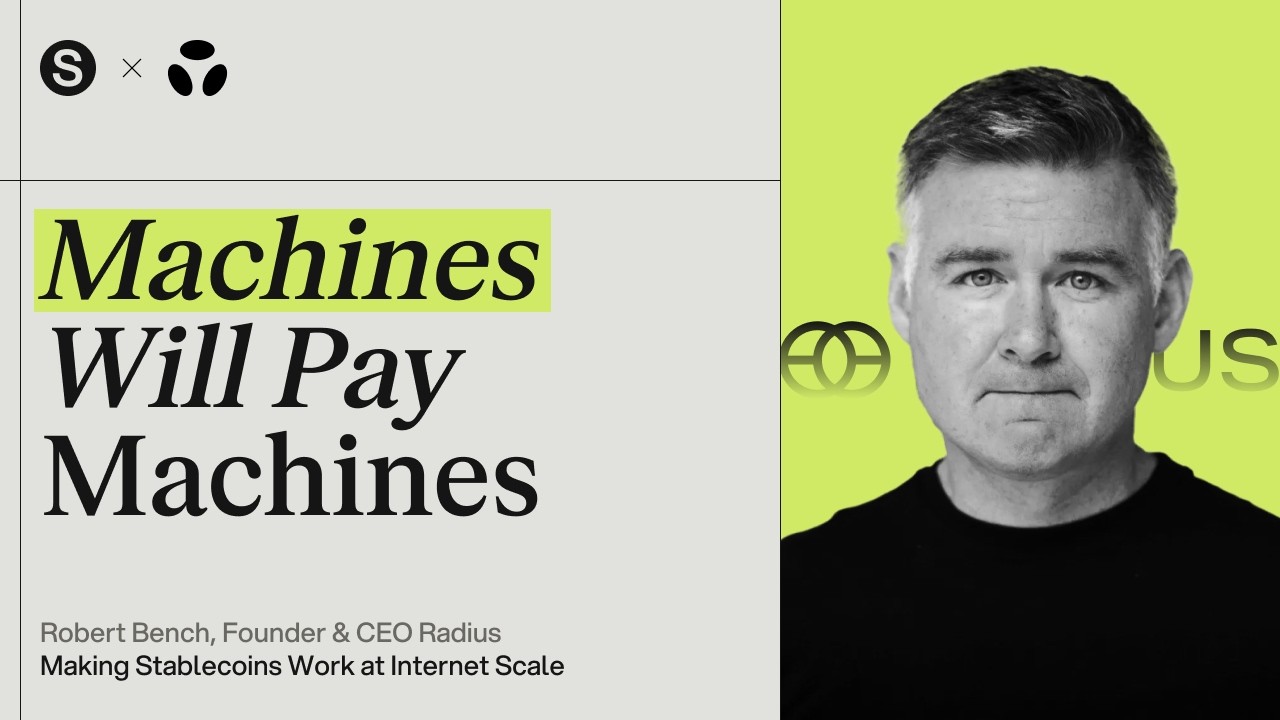
Robert Bench helped design USDC at Circle, then left that rocket ship for national service and spent four years at the Federal Reserve Bank of Boston with MIT engineers building Project Hamilton. That research became the foundation of Radius, backed by Lightspeed. Radius launched mainnet on March 5th at A Very Stable Conference Season 2, with Brale handling fiat on and off ramps and SBC as the stablecoin partner.
This conversation covers the whitelist vs blacklist decision that shaped USDC's openness, the "Sputnik moment"that pulled Robert into government service to compete with China's CBDC, and why Visa's 84% operating margin is vulnerable to stablecoin compression. The core insight: Visa wins human payments. The frontier is machine payments, and most stablecoin infrastructure is still built around human latency.
Radius is not a blockchain. It's a smart contract execution database, fully EVM compatible, with stablecoin transfers at $0.0001. Robert walks through why the ad-based internet is broken, how native machine-to-machine money restructures the incentives, and what happens when stablecoin infrastructure becomes fast enough and cheap enough to monetize the internet itself.
Timestamps:
1:21 - Robert Bench introduction
2:12 - From the Treasury Department to Circle to the Federal Reserve
3:52 - Helping design USDC and competing with Tether
7:45 - The whitelist vs blacklist decision that shaped USDC's openness
9:23 - Why stablecoins track money better than traditional banking
12:39 - Leaving Circle for national service: Project Hamilton at the Federal Reserve
15:44 - Project Hamilton, MIT engineers, and scaling EVM execution at the Fed
20:20 - China's CBDC threat: the Sputnik moment for the US dollar
22:05 - Visa's 84% operating margin and why stablecoin compression is inevitable
24:34 - Human payments vs machine payments: where the real frontier is
27:00 - The Cloudflare comparison and why Radius is built for machine-scale
28:09 - The ad-based internet is broken and what replaces it
31:11 - "We are not a blockchain. We are a smart contract execution database."
32:19 - Radius Labs: building for AI and LLM applications that need machine-based payments
33:43 - EVM compatible: if it runs on Base or Monad, it can run on Radius
This season is powered by Brale
With Brale, you can launch stablecoins in minutes and actually make them usable. Their single API unifies licensing, custody, on-ramps and off-ramps. They're the stablecoin issuer for emerging ecosystems like Canton and Radius, and core infra for payments teams like Coinflow, Rain, and hundreds of others.
Learn more at brale.xyz
Guest: Robert Bench, CEO & Co-Founder at Radius
Host: Drew Rogers
Follow Stabledash on X: @stabledash
Follow Robert on X: @RkBench
Learn more about Radius: https://www.radiustech.xyz/
The content of this podcast is for informational purposes only and does not constitute financial, investment, or legal advice.