Stabledash

Stabledash
Insights
Legacy settlement forces trillions into idle buffers. Programmable settlement and bank-issued digital money unlocks always-on global treasury.
January 14, 2026
Companies mentioned:
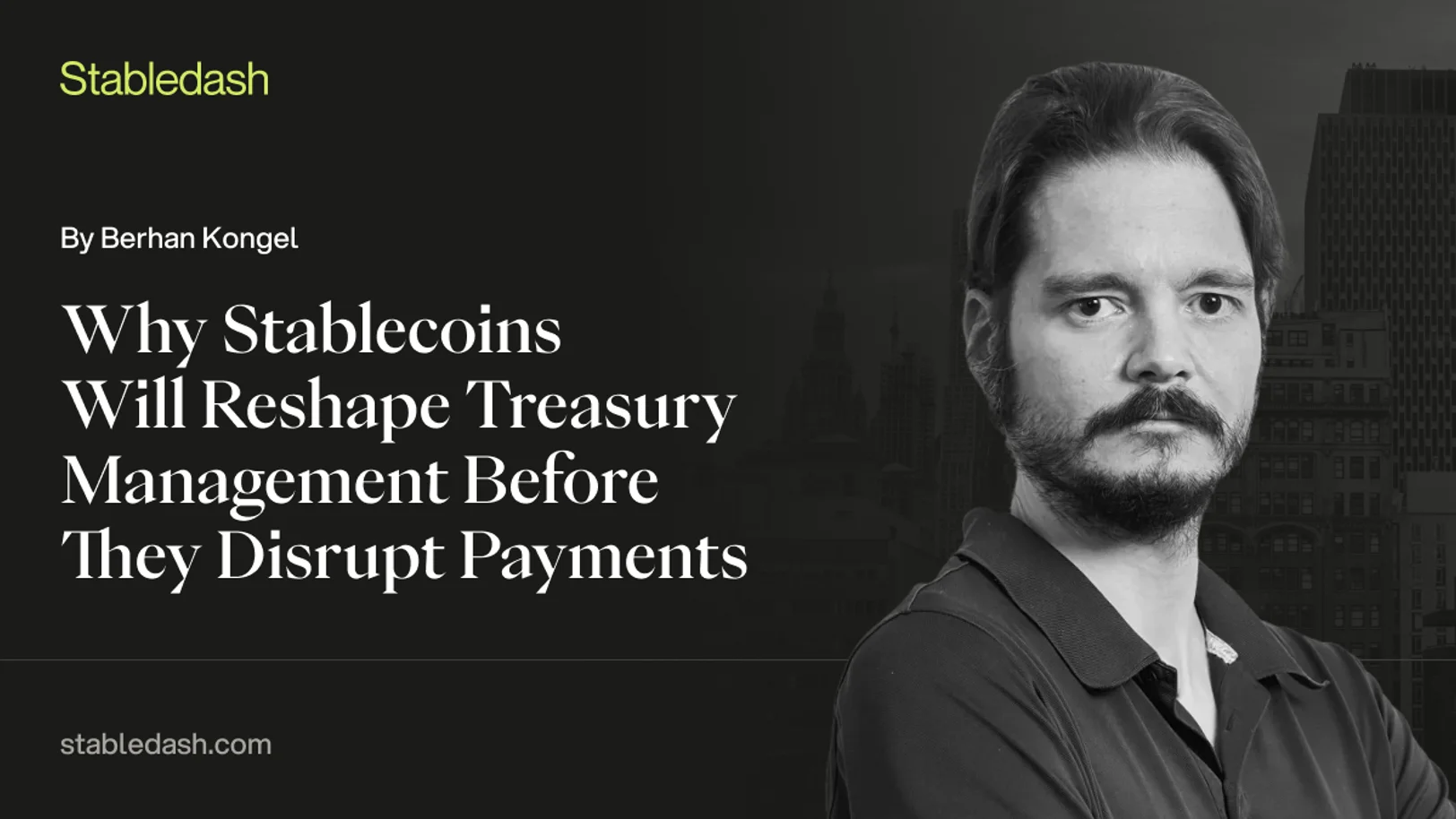
Why Stablecoins Will Reshape Treasury Management Before They Disrupt Payments
At any given moment, trillions of dollars sit idle across the global banking system.
This is not because companies are inefficient or overly conservative, but because traditional settlement infrastructure demands it.
Capital is routinely parked as a buffer to ensure payments settle on time, even if that means sacrificing yield, working capital efficiency, or growth.
In practice, this money exists as insurance against uncertainty. These idle balances typically sit in what the industry calls nostro accounts: pre-funded balances held in foreign jurisdictions and currencies so cross-border obligations can settle even when rails are slow, opaque, or temporarily unavailable.
A subtle yet important detail is often lost here. “Nostro” and “Vostro” are not different accounts.
They are the same account viewed from opposite sides of the ledger. Nostro means “my money held with you.” Vostro means “your money held with me.” The distinction matters because it reveals the system's true structure.
What appears to be a network of accounts is, operationally, a single balance replicated across institutions to compensate for timing risk.
This is why moving money across borders still feels archaic.
Pre-funding is not a legacy preference. It is the system’s workaround for uncertainty and counterparty risk. While most headlines focus on payments themselves, the deeper structural opportunity sits upstream in treasury, liquidity, and settlement design.
The prize is straightforward: reduce the buffers forced by legacy settlement and release capital back into productive use.
Much of the public discussion around stablecoins starts with theory. The real story begins with operations. Treasury teams live inside cut-off times, RTGS windows, correspondent dependencies, and exception queues. Anyone who has ever delayed a vendor run because a cross-border payment disappeared into a black box understands the problem instinctively.
In practice, treasury is still a forecasting and buffer-management function. Funds move across jurisdictions and time zones in discontinuous cycles, with limited visibility once they leave the originating bank. When something goes wrong, resolution rarely involves real-time dashboards or APIs. It still looks like phone calls across banks and correspondents, often spanning multiple regions.
Consider a mid-sized enterprise operating across four jurisdictions and three currencies. Cash inflows are concentrated in the United States, while vendor obligations are concentrated in Germany. The company generates far more USD than EUR, yet must reliably pay euro-denominated suppliers.
To do so, USD must be converted, routed, and settled into EUR at precisely the right time.
Here is where operational reality intrudes.
Germany operates six hours ahead of the US. Local RTGS systems run on limited daily windows. A payment initiated late in the US business day may miss the European settlement window entirely. Funds leave the originating account but arrive too late to be usable. Until the next cycle opens, that capital is effectively frozen.
To manage this risk, treasurers over-provision.
Cash is spread across jurisdictions and institutions. Liquidity is split between operating accounts, brokers, custodians, and money market funds to maintain optionality. Yield is accessed, but only at the cost of additional complexity. Complexity is tolerated because failure is unacceptable.
The system is also fragile.
One day, a SWIFT transfer clears smoothly. The next day, a routine compliance review diverts the payment into exception handling. Nothing malicious has occurred, yet timelines become unpredictable. These delays force even larger buffers, trapping more capital in the process.
This is the hidden tax on global business.
This architecture was not built out of ignorance. It was built to manage risk.
In 1974, Bankhaus Herstatt was shut down by German regulators in the middle of the business day. Because of time zone differences, US banks had already sent Deutsche Marks but had not yet received the corresponding US dollars. One side of the trade settled, the other never did.
This failure mode, known as Herstatt risk, remains the core fear in cross-currency settlement: paying out one leg of a transaction without certainty that the other leg will arrive.
To mitigate this risk at scale, the industry built CLS (Continuous Linked Settlement), a neutral settlement system designed to enforce payment-versus-payment.
Both sides of a trade settle together, or not at all.
CLS works, but within narrow constraints. It supports a limited number of currencies, operates in defined windows, and sits on top of legacy rails. Outside those parameters, the system reverts to pre-funding and trust.
Even today, a meaningful share of global FX activity settles outside full PvP protection, which is why large buffers of idle capital remain a structural feature of global finance.
Atomic swaps introduce something more important than speed: determinism and operational continuity.
Unlike CLS, which relies on 3rd party trust and manual coordination to execute a PvP settlement, atomic swaps use programmable rules via smart contracts to ensure that both legs of a transaction execute together or not at all. There is no interim state where one party has paid and the other has not.
This matters because it removes timezone as a source of settlement risk. Execution no longer depends on overlapping banking hours or local RTGS windows. It depends on conditions encoded in what’s called a Hashed Timelock Contract (HTLC), which are cryptographic smart contracts where settlement conditions are encoded.
As settlement becomes deterministic, the need for oversized buffers diminishes. Treasury shifts away from hope-based timing toward execution guarantees.
However, atomic swaps alone are insufficient. They solve the logic of settlement, but not the problem of scale.
Atomic swaps are the engine.
Liquidity is the fuel.
This is where the narrative that stablecoins can replace all settlement infrastructure encounters its limits.
Global FX markets move several trillions of dollars per day.
Stablecoin markets, while growing, remain orders of magnitude smaller. USD-denominated stablecoins have depth.
Non-USD stablecoins do not. At institutional scale, thin liquidity translates directly into wider spreads, especially in the jurisdictions where liquidity is needed most.
This is why bank-backed deposit tokens are critical. A stablecoin is typically issued against reserves. A deposit token represents a claim on a regulated bank’s liability, expressed in programmable form.
That distinction is fundamental.
Banks can expand credit within regulatory frameworks. Stablecoin issuers generally cannot. If programmable settlement is to operate at global scale, the liquidity engine of the commercial banking system must be brought onto programmable rails.
This is no longer theoretical.
Major institutions are already operating deposit-token-based systems in production. JPMorgan has processed hundreds of billions of dollars through JPM Coin (JPMD), its deposit token, via the Kinexys system. Partior is running live multi-currency interbank settlement corridors. Fnality has been designated a systemic payment system by the Bank of England.
More importantly, these systems are no longer confined to closed interbank environments.
JPMD is already live on Base, an Ethereum Layer 2, albeit for limited use cases today. The implication is profound. Bank deposits can now exist natively alongside stablecoins on public blockchains, enabling 24/7 programmable liquidity without relying on traditional RTGS rails.
To make this concrete, imagine an enterprise holding USD at JPMorgan.
That USD can be converted into JPMD at any time, minted directly on Base. From there, it can be swapped atomically into USDC, then into a tokenized money market fund, such as a Janus Henderson AAA-CLO vehicle, yielding over 5%. From USD to yield in seconds. No intermediaries. No Herstatt risk. No banking-hour constraints.
Fully programmable and reversible in real time.
Now imagine this model extending beyond USD to all major currencies. Unlike automated market makers, deposit tokens arrive with embedded liquidity from the banking system itself. There is no need to wait years for sufficient depth in non-USD stablecoins to develop. Liquidity is already there.
When deterministic settlement meets bank-scale liquidity, treasury changes character. It stops being a historical record of past allocations and becomes a real-time programmable routing system.
Capital no longer needs to be positioned days in advance to meet uncertain settlement windows.
It can remain productive until the moment an obligation must settle, then convert atomically into the required currency or instrument.
This shift is not primarily about faster payments.
It is about sovereignty over liquidity. Even modest reductions in settlement latency free meaningful amounts of collateral.
The SEC and DTCC estimated that moving from T+2 to T+1 in securities settlement freed up approximately $3.5 billion in daily collateral.
Applied across cross-border treasury operations, the impact becomes structural rather than incremental. Yield management, FX, and liquidity routing converge into a single programmable layer.
This is no longer theoretical.
Bank-issued digital money is already settling real value. Interbank networks are operating beyond traditional hours. Deposit tokens are beginning to bridge regulated balance sheets with programmable rails.
What changes next is not whether this works, but who adapts first.
Buffers are a symptom of non-deterministic settlement. As settlement becomes programmable and liquidity interoperable, parking capital becomes increasingly difficult to justify.
The organizations that win will not be the ones that move money marginally faster.
They will be the ones who redesign treasury to route capital dynamically, rather than guess where it needs to sit.
Learn more about Keyrails at https://keyrails.com/
The Quantum Layer: Rethinking Stablecoins for Emerging Markets | Berhan Kongel, Keyrails
The Stabledash newsletter keeps you off the timeline and dialed into modern money.
Join leaders at Circle, Ripple, and Visa who trust us for their stablecoin insights.