Stabledash

Stabledash
Insights
Firms are losing revenue not because capital is unavailable, but because fragmented systems prevent real-time visibility and decision-making when it matters most.
April 25, 2026

Companies mentioned:
You Can’t Miss What You Never Attempted: The Hidden Cost of Fragmented Capital
When a head of operations or head of product authorizes a high-value payout, the priority is immediate: "Can we fund it right now?" They need to know the constraints of that transfer instantly. For most institutional firms, the honest answer remains elusive. The capital exists, but it sits scattered across treasury spreadsheets, custodian portals, bank balances, and stablecoin wallets that often only reconcile at the end of the day.
By the time a treasury team confirms they can move the funds, the asset data is stale. The funding window closes. This scenario illustrates the hidden cost of modern finance. Firms cannot calculate the value of transactions they never execute because they lack the visibility to authorize them.
This friction is often misdiagnosed as a trading issue. It is not. It is a fundamental transaction-operations crisis. Whether the task is a customer payout, a merchant settlement, a collateral move, or an internal wallet sweep, the operational question is identical: What is available, where is it located, who controls it, and what are the constraints?
When the source of truth is fragmented, operations, treasury, and product teams are forced to guess. They buffer capital inefficiently to cover the gaps. The cost is not just a missed trade; it is the inability to automate the flow of value. It is revenue that cannot be captured and risk that cannot be managed because the infrastructure for decision-making does not exist.
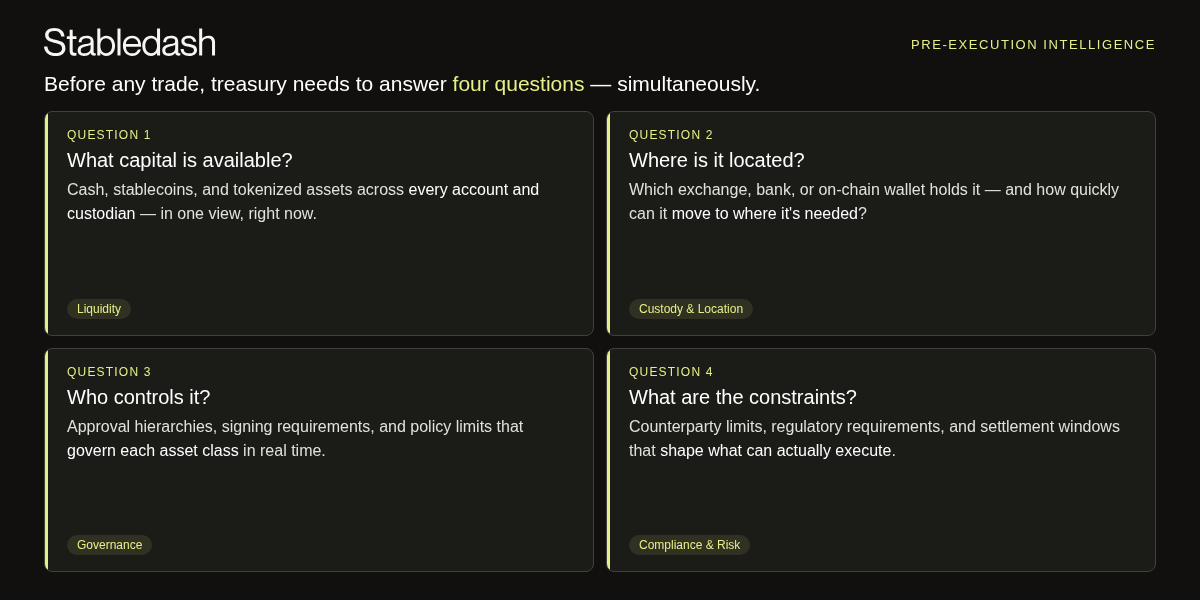
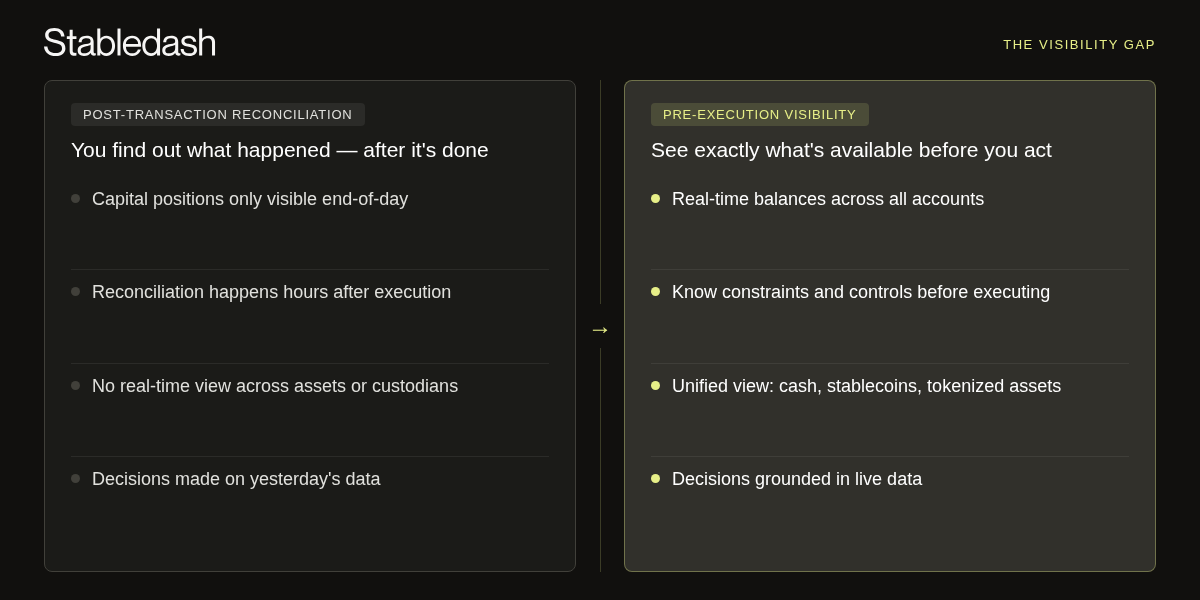
Most industry conversations focus on post-transaction reconciliation. This process fixes the accounting. Pre-execution visibility, however, determines the economics.
During my time at BlackRock, we reconciled positions hours after the market closed. Consequently, morning allocation decisions relied on data that was essentially a day old. This creates a fundamental visibility gap.
In the current landscape, operations teams and product leads pull balances from multiple systems manually. They check which assets are encumbered versus free to move. They attempt to confirm who controls which wallet and which account. Then, they must validate whether moving those funds violates policy limits, approvals, or counterparty rules.
This manual workflow creates "stale data decision-making." Teams operate with information that lags behind the market. This isn't about fixing what happened yesterday; it is about enabling what needs to happen today.
To understand the mechanics of this failure, one must look inside the operations teams of major financial institutions and fintechs. The reality is often a manual aggregation struggle.
Consider a firm managing significant digital asset flows. The head of operations might open a spreadsheet at the start of the day and manually check ten different accounts—bank portals, custodians, and wallets. They record the numbers. Every hour or two, they repeat the process. They run a multi-million dollar operation on a system of manual refresh.
This fragmentation deepens with "omnibus" account structures. A bank might view a large Bitcoin holding within a custodian interface like Fireblocks. They see the aggregate assets, but the interface often obscures the critical sub-account ownership data. They cannot immediately see which client or stakeholder owns specific portions of that liquidity.
The problem compounds exponentially with multi-chain operations. USDC on Ethereum differs operationally from USDC on a different chain. They require separate tracking, separate workflows, and separate reconciliation logic. Each new rail or chain added to the stack multiplies the fragmentation.
A common narrative suggests that blockchain technology solves this through instant settlement. This view overlooks the institutional reality. The blockchain settles instantly; the institution does not.
Approvals, compliance checks, and multi-system coordination remain necessary steps. We see asset managers aiming to run delta-neutral, balance sheet-efficient strategies—such as repo or loan-style strategies with high yield—using both traditional and digital assets.
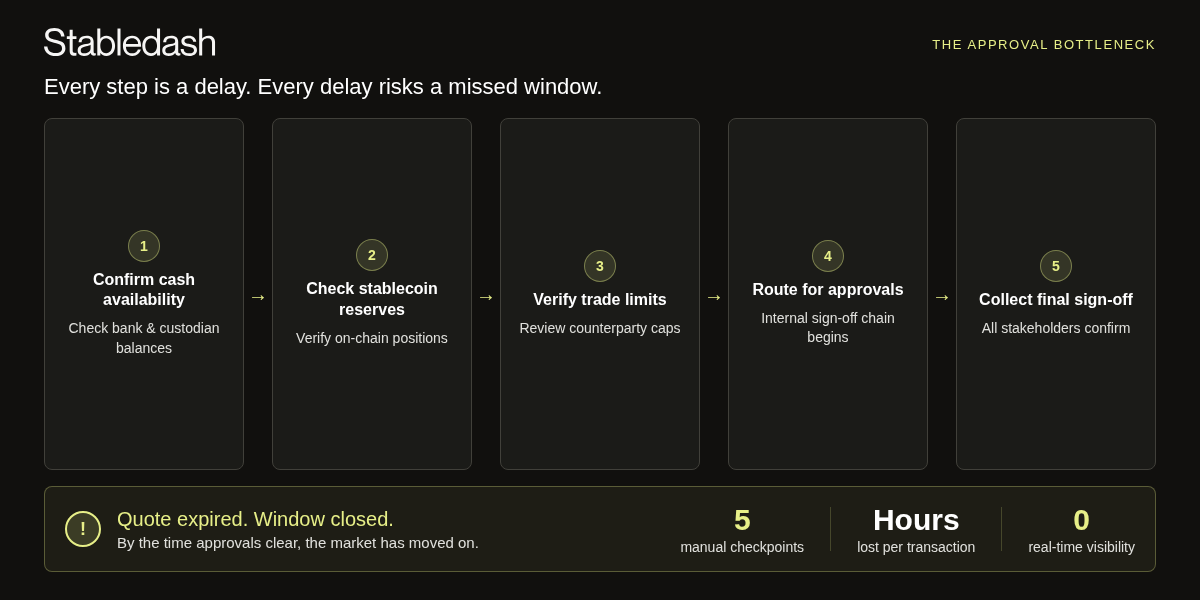
However, the workflow to execute is manual. The team must confirm cash across traditional accounts, check stablecoin balances, verify exposure limits, and route funding through multiple approvals. In a fragmented system, these approvals happen sequentially across different platforms.
By the time the capital is confirmed and the approvals are collected, the quote has expired or the funding window has closed. The transaction is no longer viable. The bottleneck is not the settlement speed of the asset; it is the decision-making speed of the firm, constrained by a lack of unified visibility.
The solution lies in treating real-time capital visibility as core infrastructure. Firms need a consolidated view that allows them to see and act on their full capital picture before the transaction execution.
This visibility prevents the accumulation of excessive cash buffers. When operations teams lack confidence in their real-time liquidity, they run larger buffers to be safe. They avoid tight-timing strategies. They bias towards using fewer venues, even if it is suboptimal for the business, simply because the operational complexity of adding more providers introduces risk they cannot scale.
Goldman Sachs recognized this shift early. Their leadership understood that in a tokenized world, treasury teams cannot operate separately from digital asset teams. They must function as one unified operation. Running two separate books for the same company creates a structural disadvantage.
Engineering teams often fall into the "build vs. buy" trap here. They build internal solutions optimized for one asset, one flow, or one business use case—perhaps a stablecoin pilot on a single chain. Six months later, the business wants to swap the chain or add a tokenized money market fund. The internal build fails structurally because it wasn't architected for a multi-asset, multi-venue operating model.
In clearing and settlement contexts, treasury and operations desks often wait. They hesitate to redeploy capital or rebalance collateral because they cannot see final available liquidity with confidence until the end-of-day reconciliation.
This hesitation creates a direct cost. Idle capital accumulates opportunity loss on a per-minute basis. This is particularly acute in digital asset markets, where volatility and yield opportunities move rapidly.
The integration gap between digital assets and traditional finance is rarely a failure of the assets themselves. It is a failure of the "source of truth." When the source of truth is fragmented across a treasury spreadsheet and a blockchain explorer (or other custodian and wallet services), the firm loses the agility required to capture value.
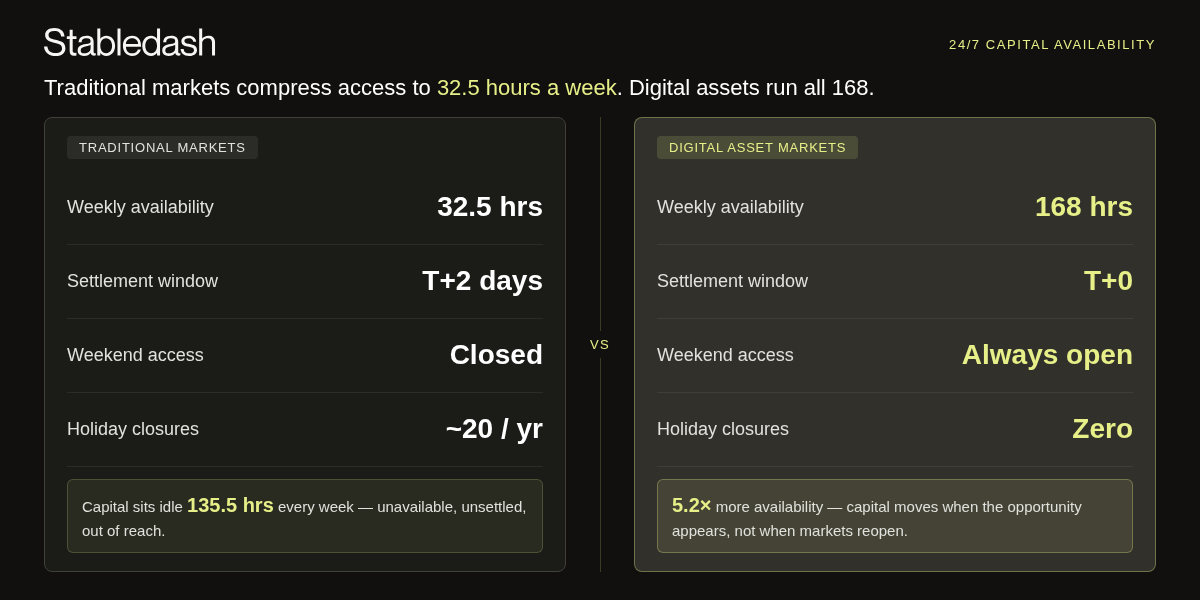
The cost of this invisibility is quantifiable when comparing market structures. Traditional equity markets operate roughly 32.5 hours per week. Crypto exchanges operate 168 hours per week. This represents a more than fivefold increase in decision windows.
If a firm’s capital visibility updates only once or twice a day, they operate blind for the majority of the market's activity. Bitcoin’s volatility can shift the landscape significantly within those blind spots. Delays in capital deployment translate directly to P&L swings.
Furthermore, switching costs in the digital asset space are compressing. Firms that started on one network are already looking to add or switch to others like Canton, Tempo, or Arc. The cycle of technology adoption has accelerated from years to months. Firms relying on rigid, fragmented infrastructure cannot pivot fast enough to capture these shifts.
The firms that win the next decade will treat capital visibility as dynamic infrastructure, not a static reporting function. They will recognize that on-premise, unified solutions solve the "client-side problem" of ingesting new technologies without ripping and replacing their existing mainframe systems.
Operations and product leaders face a critical task: calculating the opportunity cost of their current fragmentation. It is easy to count the cost of a failed settlement. It is much harder, yet far more vital, to calculate the value of the transactions the firm never attempted.
The firms that outperform over the next decade will not only do so because they adopted better types of digital asset financial products or networks. They will do so because they built better operational infrastructure — the kind that tells them what they have, where it is, and whether they can move it, how to move it, before they need to act. For operations and product leaders, the most important number is not on any report. It is the value of the transactions your firm never attempted.
The Stabledash newsletter keeps you off the timeline and dialed into modern money.
Join leaders at Circle, Ripple, and Visa who trust us for their stablecoin insights.